
The Weight of the Archive
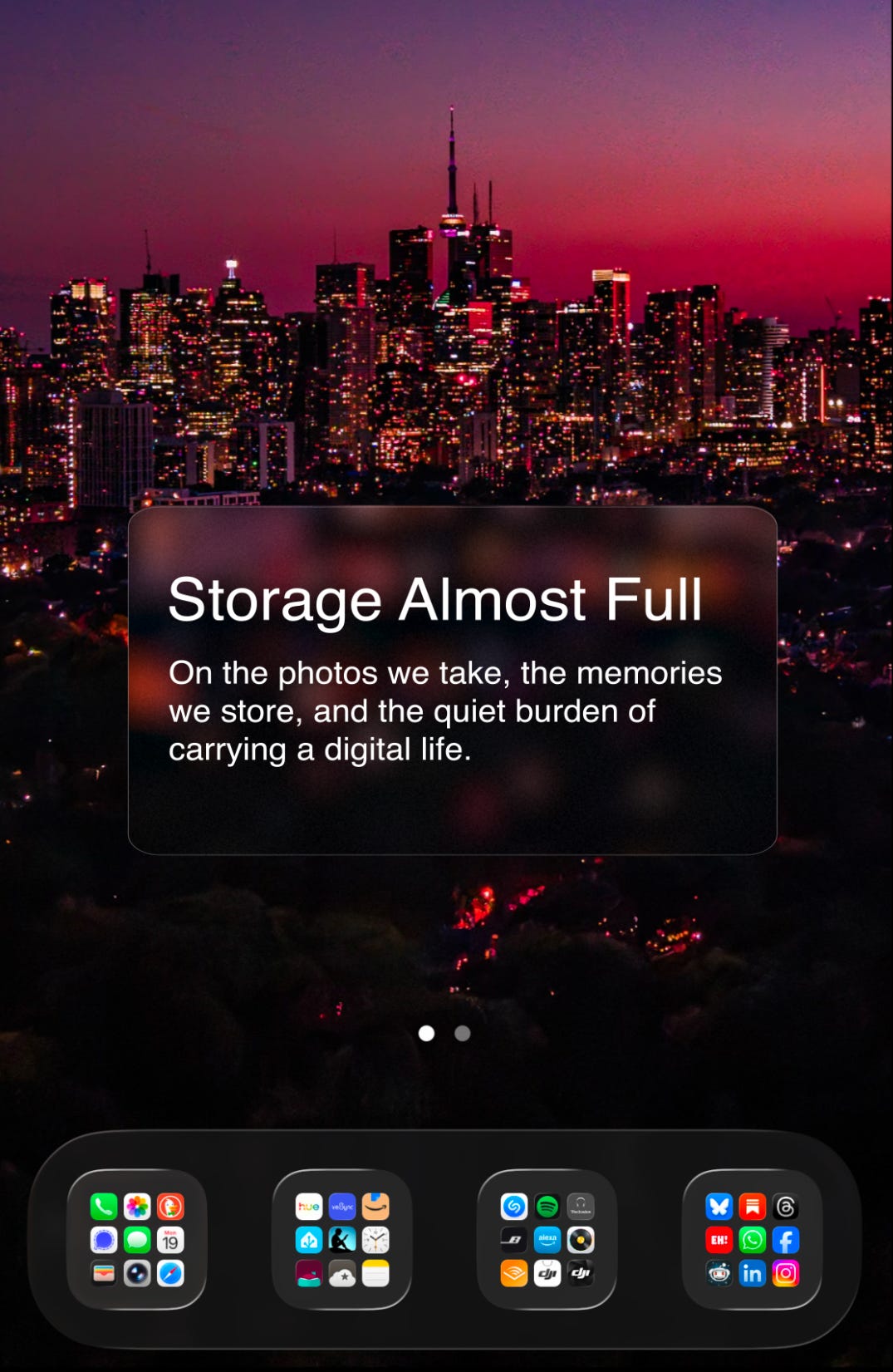
The photos we take, the memories we store, and the quiet burden of carrying a digital life.

The first sign that something’s off is always the notification.
Storage Almost Full.
A small panic disguised as a polite banner.
I open my camera roll, and suddenly I’m looking at a version of my life I barely remember: ten angles of the same sunset, a cappuccino I drank last spring, a thirsty gym pic that never made it anywhere, a concert video where you can’t see anything except noise pretending to be light.
None of these moments are important. And yet deleting them feels like erasing evidence that I existed in the spaces between big memories.
It’s unsettling how quickly the ordinary becomes sacred once a device threatens to take it away.
⸻
Somewhere along the way, without permission or instruction, we became archivists of our own lives. Not historians. Not curators. Just people trying to manage thousands of tiny proofs that we were awake, and bored, and hopeful, and lonely, and alive. Proof we won’t revisit, but can’t seem to part with.
I scroll through the photos and realize most of them aren’t moments, they’re impulses.
A dog walk.
A bar night.
A blurry selfie taken at 1 a.m.
Screenshots of things I swore I’d read later.
The CN Tower on a Tuesday.
A meal whose taste I already forgot.
Individually, they’re meaningless; collectively, they feel like sediment.
A quiet buildup of life I never organized and never fully lived again.
I always wonder why it’s so hard to let any of it go.
Maybe it’s because every photo, even the useless ones, carries a trace of who I was in the split second before the shutter. The version of me that wasn’t thinking about the future or the past, just capturing something that mattered for reasons I’ve already lost.
⸻
And then there’s the cost of keeping everything.
Cloud storage creeps higher each year.
Switch phones, and suddenly Apple or Google wants more money to “restore your memories.”
It’s a brilliant manipulation: nostalgia as a monthly bill.
Delete nothing. Pay forever.
A subscription to your own life.
What makes this even stranger is that most of us never look back.
We don’t scroll into the archives.
We don’t rewatch the concert clips.
We don’t study the group photos where half the people are now strangers.
We don’t revisit the screenshots of quotes we saved during minor emotional crises.
These photos sit untouched, aging in pixels, waiting for an audience that will never arrive.
It’s digital noise pretending to be history.
⸻
And then there’s the trend that tries to solve the problem with performance: the photo dump.
“November dump.”
“My week, unfiltered.”
“My camera roll lately.”
I see them everywhere, collages of leftovers stitched into a carousel and posted like a confession. But I don’t tap through them. I don’t think anyone does. We’re all posting them, nobody’s watching them. The feeds are full of these things, thousands per second, each one a wordless gesture that says I was here, I did things, here’s proof.
Something about the phrase “dump” admits the truth up front. It feels like emptying your pockets onto the table and calling it storytelling. No captions. No thread. Just volume. Add the templates with the identical transitions, the same songs cycling through everyone’s reels, and the whole thing becomes a genre of repetition. Less a memory, more a mood board made by someone else’s algorithm.
It raises an uncomfortable question: if we’re not looking at other people’s dumps, and they’re not looking at ours, then what exactly are we keeping all these moments for?
⸻
There’s a deeper layer to the emotional archive.
Old versions of myself show up in the roll: younger, softer, more open, less guarded.
Some photos I’m proud of. Others make me feel a quiet ache I can’t fully name.
And then there are the ghosts: people who mattered once, people I loved, people I hurt, people who drifted, people who disappeared without a scene. The photos remain long after the story has ended. Sometimes I don’t delete them because I can’t. Sometimes, because I don’t want to. Sometimes, because I forget they’re even there until they land like a small punch to the stomach.
My body always reacts first
a drop in the gut,
a tightness in the chest,
a rolling anxiety wave that moves downward like a fast shadow,
a flicker of fear I recognize but can’t quite place.
The photo is neutral.
The memory is not.
⸻
A few years ago, I started doing something different. I only keep about a year of photos on my phone. Everything older goes somewhere else, not deleted, just moved deeper.
The rest sits on a NAS tucked behind my TV, out of sight, humming quietly on the network. Everything encrypted, backed up, safe from the cloud’s monthly hostage negotiations. It’s comforting knowing it’s all there, even if I rarely open it.
But even I ask myself: what am I supposed to do with a vault of moments I never revisit?
I don’t have a clean answer.
Maybe no one does.
Some people curate yearbooks of their lives. Some ruthlessly delete everything that doesn’t spark something immediate. Some leave the whole mess untouched because sorting feels like heartbreak.
Most of us do a confused mixture of all three.
⸻
Maybe the point isn’t a perfect archive. Maybe it’s just presence, not documenting everything, but noticing what actually shaped you. Letting go of the versions that don’t fit anymore. Accepting that memory and meaning aren’t the same thing.
Our devices are built to remember everything.
We weren’t.
And somewhere in that mismatch is the quiet ache of modern life: we’re carrying an impossible amount of ourselves.
I don’t know if the real work is organizing the archive or just living without needing so much proof. Maybe it’s trusting that the moment was enough, even if the photo wasn’t. That the feeling mattered even if the file didn’t.
The photos aren’t the life.
They’re just the trace.
And the trace is only there to remind you that you lived something worth keeping.